Hiking

Cliff Gilker Park Hike on the Sunshine Coast, BC


Cliff Gilker Park near Roberts Creek on the Sunshine Coast is a great place for a short and easy hike. It has a network of forested trails that lead to lots of waterfalls and cascades. If you love moss, ferns, mushrooms, and tall Douglas firs, this hike is for you.

I lived in Gibsons for five months in the winter of 2020/21. The easy trails of Cliff Gilker Park were a short drive away in Roberts Creek. I found myself heading there often for a short nature break. The forest is especially gorgeous on cloudy or drizzly days. (I think it’s one of the most beautiful hikes on the Sunshine Coast.)

I’ve explored all the trails in the park and each of the waterfall viewpoints. That means that I’m able to give you a local’s insider info on everything you need to know to hike in Cliff Gilker Park.

In this post you’ll find:

Basics

Cliff Gilker Park is a small forested park with a network of trails. Roberts Creek and Clack Creek run through the park and both have some beautiful waterfalls, cascades, and sections of gorgeous mossy canyon.

You can use the park map (below) to plan your own trip. But I’ve put together a loop hike for you that visits all the best spots. Stats for my recommended loop are below.

Distance: 3 km

Elevation Gain: 50m

Time: 1 hour

Difficulty: Easy

Season: Year-Round

Toilets: Washroom building with toilets at the main parking lot.

Dogs: Allowed on leash

Cliff Gilker Park Hiking Map

Navigating the trails in Cliff Gilker Park is easy with frequent colour coded markers to show which trail you are on and mini maps at major junctions.

How to Prevent Blisters When Hiking

I’ve been on countless backpacking trips over the years (I’m a hiking guidebook author), but somehow I still end up with blisters every few years. I know all the tips and tricks to prevent blisters when hiking – but I just need to remember to follow my own advice!

Since I’m usually blister-free, here’s how to prevent blisters when hiking… and how to treat blisters when you do get them. Some of the tips are fairly straightforward (your shoes should fit you) but a few aren’t often talked about. For example, I’m a firm believer in good boot lacing technique.

This guide to preventing and treating blisters includes:

Hey there: Some of the links in this post are affiliate links, which means I earn a small commission at no extra cost to you if you make a purchase. I only recommend products that I have used and believe in. Thanks for supporting my website! -Taryn

Why Do Hikers Get Blisters?

So first things first: Why blisters? Blisters form when skin gets irritated or damaged by pressure or friction. This could be from tight spots in your hiking boots or wrinkles in your socks.

You’ll also be more prone to blisters if your feet are wet, either from sweat or from getting rained on or dunked in a stream. When I get blisters, it’s usually because I let my feet get waaaay too sweaty 🙁

How to Prevent Blisters When Hiking

Wear Hiking Boots That Fit Well

If your boots don’t fit or aren’t broken in, you’re likely to get blisters. Take your time when buying hiking boots and try on lots of pairs. Make sure your toes have enough room to spread out – if they are scrunched together you can get blisters.

Getting the right size is also important. Check the sizing by walking on an inclined ramp – most good outdoor stores will have one. When walking uphill your heels should stay in the same place – the boots are too big if your heel slips. Going downhill make sure that your toes don’t bump the front of the shoe. If they do, they’re too small.

Choose the Right Footwear

To avoid blisters you want to keep your feet dry. That means that your hiking boots shouldn’t let your feet get too sweaty, but they also should keep water out when you hike in the rain or splash through puddles.

Unfortunately it’s almost impossible to get boots that do both well. Waterproof boots are good at keeping water out, but even if they use a waterproof breathable membrane like Gore Tex, they still make your feet pretty sweaty. And mesh ventilated hiking boots are great at keeping your feet cool… but terrible at keeping them dry.

My solution is to wear waterproof breathable hiking boots like the Salmon Quest Gore-Tex for colder and wetter weather and ventilated mesh trail runners like the Salomon XA Pro for warmer weather.

2024 Mount Assiniboine Hiking Guide

Note: I’ve updated my Mount Assiniboine hiking guide to include updated info for 2024 including the new requirement for reservations at Porcupine Campground.

With its prominent Matterhorn shape, Mount Assiniboine is one of the most photographed peaks in the Canadian Rockies. And that makes hiking to Mount Assiniboine one of the most spectacular backpacking trips near Banff.

I had dreamed of visiting for years, but when it came time to plan my trip, I was overwhelmed with information. There are so many campgrounds and access routes to consider! I’m a hiking guidebook author who has hiked all over BC and the Canadian Rockies, so doing hiking research is my jam – I figured out the best way to get there and the best places to camp.

My visit to Assiniboine was gorgeous, and I can’t wait to go back (probably to try one of the other access routes). In this guide, I’ve got all the info I used on my hike so that you can plan your own epic Mount Assiniboine hiking trip.

My guide to hiking to Mount Assiniboine Provincial Park includes:

Mount Assiniboine Quick Facts

Description: Mount Assiniboine is a spectacular 3618-metre peak, nicknamed the Matterhorn of the Rockies. The core area of Mount Assiniboine Provincial Park is a popular place for day hikes with incredible views of Mount Assiniboine and the surrounding peaks. However, the park is very remote – it takes one or two days to hike into the park (there are no roads) and there are several approach routes to choose from.

Location: Mount Assiniboine Provincial Park is located in the Canadian Rockies southwest of Banff and Canmore. The park borders Banff National Park and Kootenay National Park.

Pronunciation: “Uh-sin-a-boyn”

How to Get There: There are five hiking routes into the park. You can also fly in by helicopter. More info in the Route Options section below.

Distance: 25.5 km to 32.3 km each way to the core area (depending on route) plus more for day hikes

Elevation Gain: 766 m to 1625 m to the core area (depending on route)

Difficulty: Moderate (if you break up the hike into the core area into two days)

How Many Days to Spend at Mount Assiniboine: Ideally 4 or 5.

Best time to Hike to Mount Assiniboine: Early July to late September.

Mount Assiniboine Weather: Mount Assiniboine is high in the Canadian Rockies and the mountains make their own weather. In July and August, the average high temperature is 23°C and the average low is 7°C. Thunderstorms in the afternoon are common. Use my picks for the Best Weather Apps for Hiking to see the forecast for your trip. I had a lot of rain and snow on my early September trip. The Mount Assiniboine webcam is also helpful.

Mount Assiniboine Reservations and Cost: You must make reservations to camp at most campgrounds in the Assiniboine core area and on the hike in (although there are some first-come, first-served campgrounds). The cost of your trip will vary depending on your itinerary. See the reservations and costs section below for a full breakdown.

What to Bring to Mount Assiniboine: This is a remote hiking trip, so you will need to bring typical backpacking gear. Don’t forget a waterproof jacket and warm layers as the weather can get cold and wet fast. Use my backpacking checklist to make sure you have everything you need and my guide to reducing your backpack weight so you don’t over pack.

Wildlife at Mount Assiniboine: The trail is in bear country (both black bears and grizzly bears). Carry bear spray, hike in a group, and make noise, especially in brushy areas. Use campground cooking areas and store all your food in toiletries in bear lockers. Read my bear safety tips for backpackers for more info.

Mount Assiniboine Rules: Dogs are allowed on-leash. No fires or drones.

Indigenous Context: The Mount Assiniboine area is in the traditional territory of the Tsuut’ina, Michif Piyii (Mestis), Niitsítpiis-stahkoii (Blackfoot / Niitsítapi), Ĩyãħé Nakón mąkóce (Stoney) and Ktunaxa ɁamakɁis. The government forced Indigenous people to leave soon after Banff National Park was created in 1885 and prohibited them from accessing their traditional territory to hunt, fish, gather, and conduct cultural practices. George Dawson, an early settler surveyor, named the mountain after the Indigenous Stoney people, who the Cree called “Assin Bwan”.

Have questions about Mount Assiniboine? Join the Mount Assiniboine Facebook Group to connect with other hikers!

The Best Weather Apps for Hiking

Finding a weather forecast for hiking can be tough because most weather apps just have forecasts for cities and towns. Since it’s so important to know the weather when you hike, I’ve put together a complete guide to the best weather apps for hiking.

I’ve been hiking and backpacking for several decades, usually in the notoriously wet weather of British Columbia, so I’ve developed lots of tips and tricks for finding weather forecasts for hiking over the years.

These hiking weather recommendations work anywhere in the world, but they are especially helpful in North America in regions where there is no cell phone service on hiking trails.

This guide includes:

This is a sensitive wilderness area. Learn how to Leave No Trace to keep the wilderness wild. Make sure you are prepared by bringing the 10 Essentials. Get ready for adventure with this checklist of things to do before every hike.

Hey there: Some of the links in this post are affiliate links, which means I earn a small commission at no cost to you. Thanks for your support. -Taryn

The Best Weather Websites and Apps for Hikers

Spotwx

While their interface is pretty basic (and maybe a little bit retro!), Spotwx is a great weather website for hikers. The thing I like best about it is you can select a pinpoint location on a map and get a weather forecast for that exact location.

As well, it allows you to toggle between multiple forecast models. I use this to get an idea of what the best and worst-case scenarios might be on my trip. They have a range of shorter and longer-term models to choose from.

I also like the way it displays data in graphs. I often take a screenshot of the graphs so I can refer to them later on my trip. The graphs are pretty small on a phone, but if you zoom in they are easy to read.

Website: Spotwx.com

Mountain Forecast

I find Mountain Forecast really helpful for high elevation trips since it provides a weather forecast for thousands of named mountains around the world. It also lets you toggle between a forecast for the peak as well as a few lower elevations (where you are likely going to be camping and hiking).

One of my favourite features of this site is the way they display freezing level and precipitation, both of which can be important in the mountains.

I like the grid display for the forecast and often take screenshots from this site on my trips. They provide a detailed three-day forecast, and then a less precise six-day forecast. (Scroll to the right to see it on mobile.)

The only disadvantage of Mountain Forecast is that it works best if you know the name of a mountain near the trail you plan to hike. But you can always just use the map on the main page to navigate to the area you are interested in, then zoom in to see if there are nearby peaks that have a forecast.

Website: Mountain-Forecast.com

Windy

Available both as a website and an app, Windy has tons of weather data. In fact, I sometimes find it a bit overwhelming. It has forecasts for thousands of named locations around the world. For hikes, you may need to search for the name of a nearby lake, mountain, etc. to find the relevant forecast.

14 Best Outdoor Activities Near Las Vegas

Looking for exciting outdoor activities near Las Vegas, beyond the casinos and bustling nightlife? This vibrant city is surrounded by sprawling natural beauty, from red sandstone peaks at Red Rock Canyon to tranquil waters at Lake Mead.

In this post, Happiest Outdoors Contributor Shannon will guide you through the best outdoor adventures around Vegas. It includes thrilling hiking trails, serene water bodies, and adrenaline-fueled desert adventures. She is a Vegas local, so she knows all the best spots. Get ready to uncover a wilder side of Sin City!

This list of incredible outdoor adventures around Las Vegas includes:

This is a sensitive wilderness area. Learn how to Leave No Trace to keep the wilderness wild. Make sure you are prepared by bringing the 10 Essentials. Get ready for adventure with this checklist of things to do before every hike.

Hey there: Some of the links in this post are affiliate links, which means I earn a small commission at no cost to you. Thanks for your support. -Taryn

Las Vegas Outdoor Activities Map

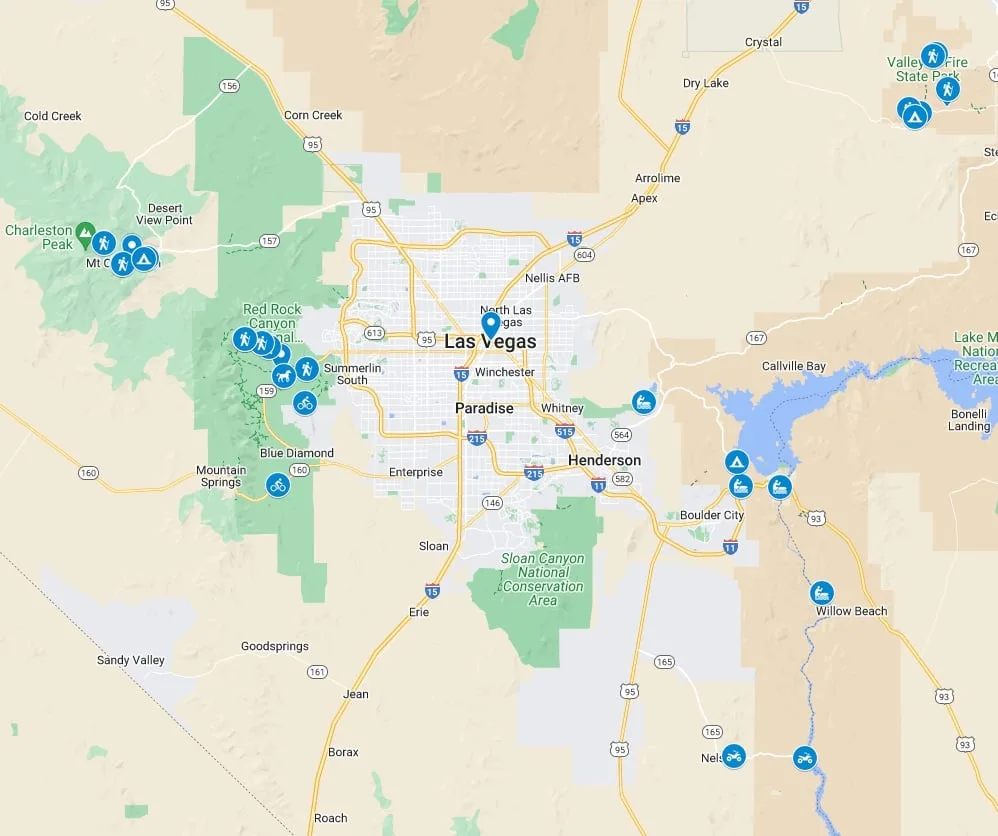
If you’re staying in Las Vegas, you’re probably wondering how far out of town you will need to go to get to outdoor adventures spots. We made a custom Las Vegas Outdoor Activities Google Map just for you that shows you all the places Shannon recommends in this post.

For some of these activities you can arrange transportation with a tour company, but for others, you’ll need to drive yourself. I like to use Discover Cars to book rental cars since it lets me compare prices across tons of companies.

Map of outdoor activities near Las Vegas
Click on the map to zoom in!

Hiking and Nature Trails Near Las Vegas

Hiking at Red Rock Canyon National Conservation Area

Red Rock Canyon National Conservation Area offers a breathtaking landscape for avid hikers. This area, located just 30 minutes from Las Vegas, hosts some of the best hiking trails near the city. Once you enter the park, you’ll find a one-way 13-mile scenic drive that leads you to many of the trailheads for hiking and exploring. The trails range in difficulty so it’s easy to pick one suited to your fitness level or desired challenge.

For first-time visitors, swing by the Visitor Center. The friendly staff provide information about various recreation opportunities tailored specifically for outdoor enthusiasts like you! 

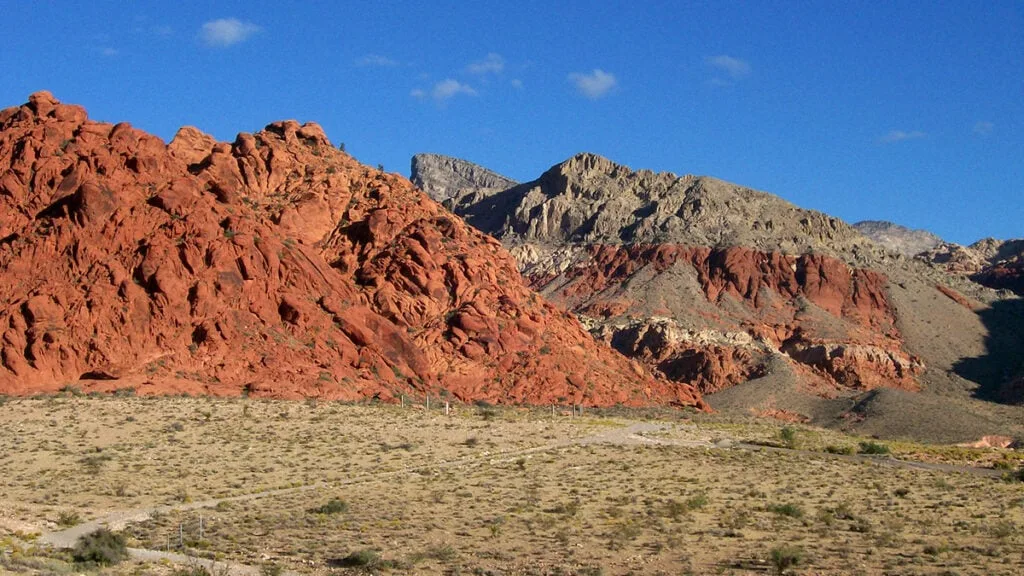
Rock formations at Red Rock Canyon National Conservation Area, one of the best outdoor activities near Las Vegas
Photo: Shannon/Three Days in Vegas

Here’s a quick rundown of some of the more popular trails:

The White Rock Mountain Loop is a strenuous trail that stands out with its different scenery, cooler temperatures, and tranquil picnic spots under pine trees.

Moenkopi Loop is a popular pick. It offers varied terrain and stunning desert vistas on an easy trail.

Calico Hills Trail gives hikers up-close views of brightly colored sandstone formations and hidden slot canyons.

The Calico Tanks Trail includes a hidden water tank at the finish line – a true oasis in the desert. Explore further along this strenuous trail for amazing views of the Las Vegas Strip.

Hiking to Turtlehead Peak gets your heart pumping while rewarding you with panoramic views of Las Vegas.

Keystone Thrust Trail brings geology to life as it passes through an exposed fault line.

Hike to Crooked Falls in Squamish

When you think of waterfalls in Squamish, you think of Shannon Falls or maybe Brandywine Falls. Those are both amazingly tall waterfalls with easy tourist-in-flipflops-friendly walks to a viewing platform, overflowing parking lots and tons of people with selfie sticks.. But what if I told you there were other awesome waterfalls in Squamish that you could actually hike to, then have them all to yourself? Welcome to Crooked Falls in Squamish!

This waterfall is interesting because… well it’s crooked, like the name. In cascades down the Sigurd Creek directly into a rock bluff, where it makes a sharp 90 degree turn before flowing downhill.  And you get to stand on the rock bluff! (I shot the video from there.) It’s a bit of a drive to get there, but the hike isn’t too difficult and the views are certainly worth it.

Driving Directions to Crooked Falls

Click for full driving directions from Vancouver . (But if you do use these directions, be aware that you will lose cell service outside Squamish so you’ll need an off-line version of the map).

Drive highway 99 to Squamish. North of Squamish turn west (left) on to Squamish Valley road – this is the same intersection as the entrance to Alice Lake Provincial Park, but you want the road on the other side of the highway.  Follow this road to a bridge over the Cheakamus River. Immediately after the bridge the road forks – go left to stay on the Squamish Valley road. The road has speed bumps as it passes through the Cheakamus Indian Reserve. Follow this road for about 19km past some homes and ranches to the end of the pavement.

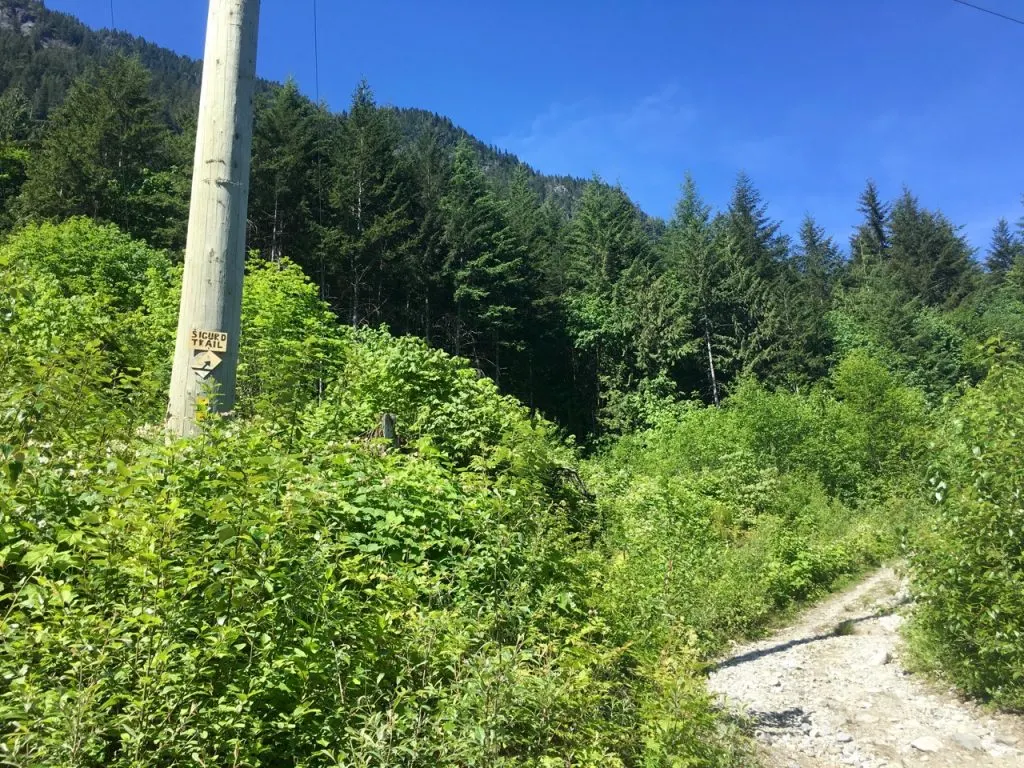
Past here you will be on the Squamish Forest Service Road, which is gravel and can be dusty, but any 2WD drive car can make it to the trailhead. About 1km after the road turns to gravel, watch for a big bridge on your left – it may be signed Ashlu Main Forest Service Road or Squamish Riverside Campground. Turn left to cross the big bridge, go past the campground (on your right), then cross another smaller bridge. Stay on the main Ashlu road for another 2km or so, then cross two smaller bridges over the Ashlu river. Right after the second bridge, park your car. The overgrown logging road heading uphill on the lefthand side of the road is the trailhead (and it has a sign that says Sigurd Trail).

Sigurd Creek Trailhead - Crooked Falls
Sigurd Creek Trailhead

Crooked Falls Hike

Distance: 7km round trip

Elevation gain: About 400m

Hikeable all year round since maximum elevation is around 500m so you are unlikely to encounter snow in the winter.  Best in the spring if you want to see the falls at maximum flow.

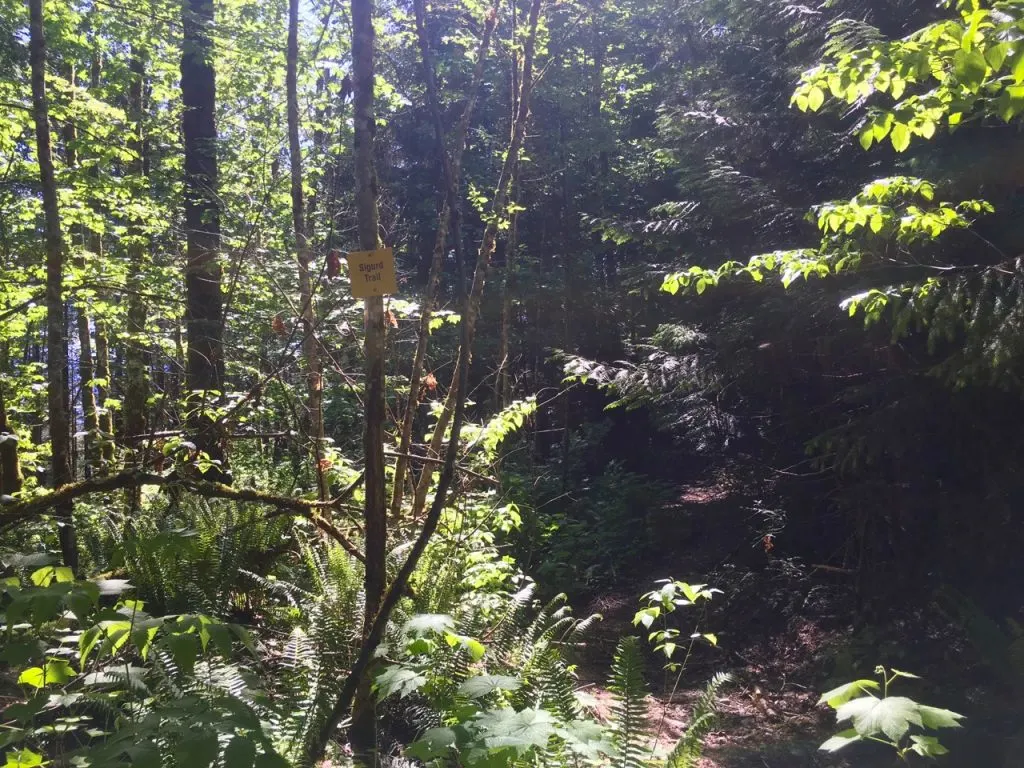
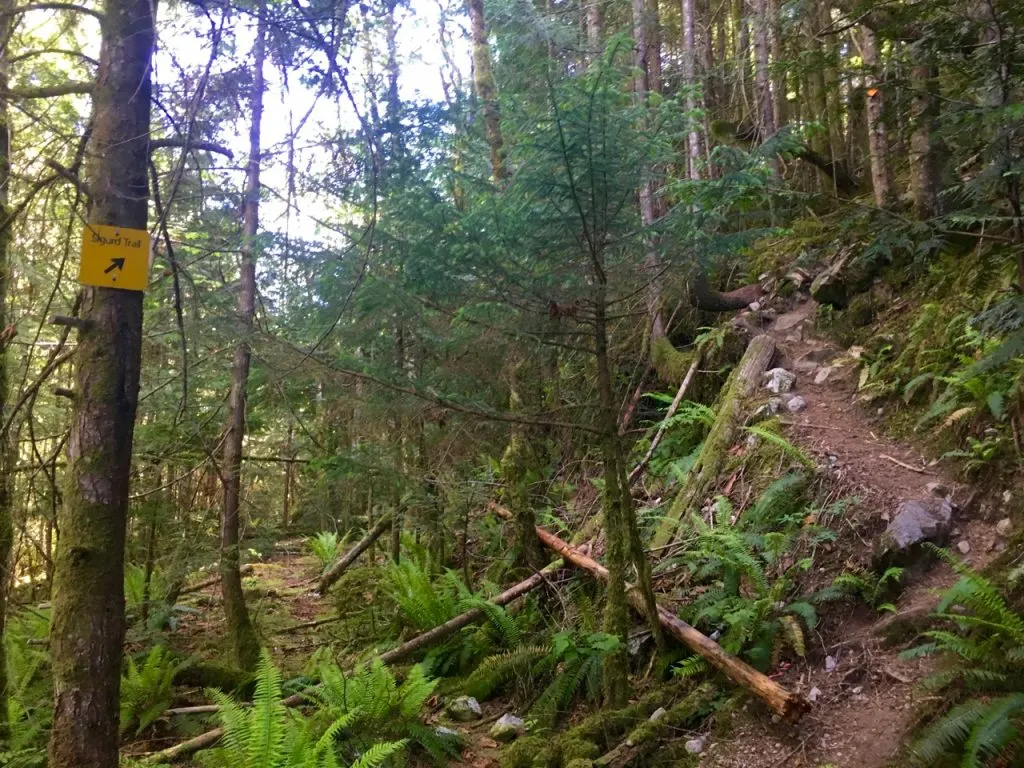
The BCMC (British Columbia Mountaineering Club) built and maintains the trail as it accesses some mountaineering and scrambling objectives higher up the mountain. The trail is well-built and well marked with orange squares so it is easy to follow. From the trailhead where you parked your car walk about 15 minutes uphill on the old road. At a switchback where the road curves right, look for a trail heading left with a “Sigurd Trail” sign.

Sigurd Trail sign - Crooked Falls
Sign marking the left turn off the old road

At this point you are on a narrow trail that sometimes widens up enough for you to tell that you are on another, even older road. You’ll pass below a huge rock wall covered in dripping moss and get glimpses of the Squamish valley through the trees. After a few hundred meters you’ll pass another trail sign indicating that the trail heads sharply up the hill.

Sigurd Creek Trail - Crooked Falls
Trail sign points uphill – the climbing starts here

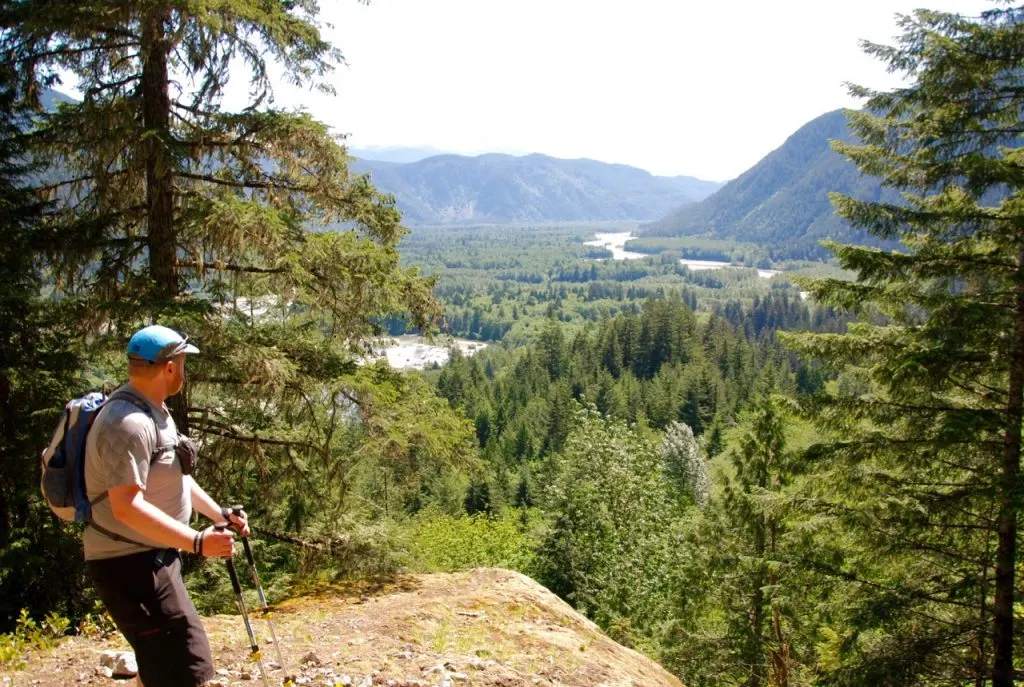
The trail climbs steeply uphill for a few minutes before popping out on a rocky bluff with a great view of the Squamish River valley.

Squamish River Valley from the hike to Crooked Falls
The view of the Squamish River Valley

Past the viewpoint the trail climbs steeply with a few breaks and passes lots of mossy rock walls, a giant boulder and a few patches of more mellow forest.

Sigurd Creek Trail - Crooked Falls
Trail sign points uphill – the climbing starts here

The trail climbs steeply uphill for a few minutes before popping out on a rocky bluff with a great view of the Squamish River valley.

Squamish River Valley from the hike to Crooked Falls
The view of the Squamish River Valley

Past the viewpoint the trail climbs steeply with a few breaks and passes lots of mossy rock walls, a giant boulder and a few patches of more mellow forest.

How to Hike and Camp at Toleak Point in Olympic National Park

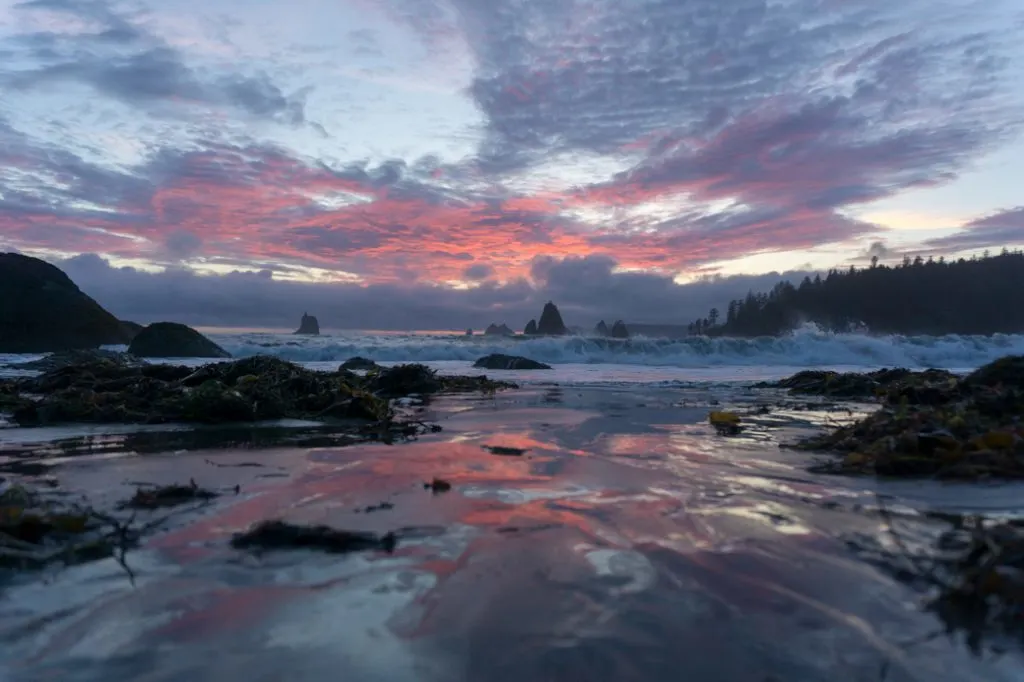
If you’re looking to explore some of Olympic National Park’s rugged coastline, I recommend hiking to Toleak Point from Third Beach. It’s a moderately challenging trail that travels along beaches and across steep headlands. The area around Toleak Point is dotted with dozens of offshore islands and sea stacks, making it really picturesque. Plus there are ah-mazing sunsets! You can hike there and back in a full day, but I think you should make it a backpacking trip and stay the night. The Toleak Point area isn’t as popular as the easier Ozette Loop or Shi Shi Beach hikes, which means you’ll experience more solitude.

However, you will have to work a bit harder for that solitude by climbing up ropes and carefully planning for the tides. I’ve done quite a few trips to the Olympic Coast so far, and I think Toleak might just be my favourite. There’s enough challenging terrain to make it a bit of an adventure, without it being too hard to be enjoyable. And the scenery… oh the scenery. If you are planning your own hiking or camping trip to Toleak Point, I’ve got all the info you need to make your trip incredible.

Hey there: Some of the links in this post are affiliate links, which means I earn a small commission at no extra cost to you if you make a purchase. Thanks for supporting my website! -Taryn

Third Beach to Toleak Point Hike Basics

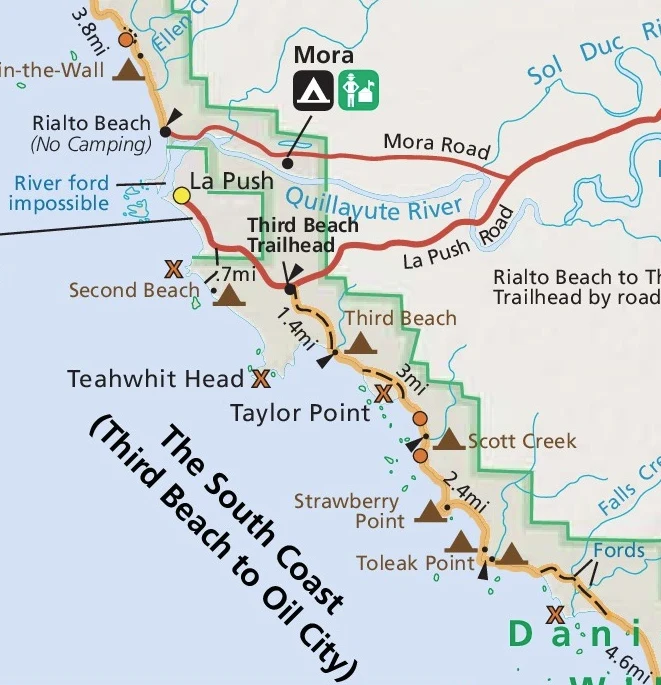
Map of the hike from Third Beach to Toleak Point in Olympic National Park.
You’ll hike from the Third Beach trailhead to Toleak Point.

Pronunciation: It’s “toe-lee-ack”. If you say “too-leek” the Rangers will giggle.

Third Beach to Toleak Point Hike Basics

Map of the hike from Third Beach to Toleak Point in Olympic National Park.
You’ll hike from the Third Beach trailhead to Toleak Point.

Pronunciation: It’s “toe-lee-ack”. If you say “too-leek” the Rangers will giggle.Indigenous Land: This route is on the traditional territories of the Quileute and Hob people’s. Toleak means “hole in the rock” in the Quileute language and is likely a reference to the large window in the sea stack just north of Toleak Point.

Distance: 6.5 miles (10.5km) one way

Difficulty: Moderate. There are some challenging ladders and rope-assisted bluffs to climb.

Time: Depends on the tides. One overnight or at least 3.5 hours each way.

What to Bring: Everything you need to be self-sufficient. Use my simple backpacking checklist to ensure you have the gear you need.

Permits: Olympic National Park pass required. Overnight visitors require a camping permit.

Tide Info: La Push Tide Table. You will want to look into the tides when planning your trip as they can make a BIG difference.

Sunset at Toleak Point in Olympic National Park

Toleak Point is on the coast in Olympic National Park. It’s actually part way along the South Coast Wilderness Trail, which is a longer and more difficult route from La Push in the north to Oil City in the south. The scenery on the northern section up to Toleak Point is just SO good. I think it’s worth heading into Toleak Point for a day trip or an overnight backpacking trip.

Toleak Point is on the coast in Olympic National Park. It’s actually part way along the South Coast Wilderness Trail, which is a longer and more difficult route from La Push in the north to Oil City in the south. The scenery on the northern section up to Toleak Point is just SO good. I think it’s worth heading into Toleak Point for a day trip or an overnight backpacking trip.