
Backpacking

25 Spring Backpacking Trips in British Columbia in 2024

After a long winter, I’m usually in a rush for summer to start so I can go backpacking. But it can be frustrating since most trails are snow-covered well into June and July. However, if you know where to look, there are lots of places to go on spring backpacking trips in British Columbia.

While this post is aimed at locations where you can go on an overnight hiking trip in spring, most of these trips make great fall backpacking trips in British Columbia too.

In BC, most mountain trails are snow-covered between late October and mid-June. However, there are lots of lower elevation trails that are snow-free between March and November. There are even a few on this list that you can backpack year-round.

This list of 25 spring backpacking trips in British Columbia includes:

  • Destinations near Vancouver, on Vancouver Island, and in BC’s interior
  • Trips ranging in difficulty from beginner to expert
  • Hikes between 2 and 8 days long
  • Trails that are usually snow-free by March, April, or May and stay snow-free until October or November
  • Tips for spring backpacking trips in British Columbia
  • Bonus: Spring backpacking suggestions for Washington State

Tips for Spring Backpacking in British Columbia

Backpacking in the spring has its own challenges. Here are a few things to watch out for:

Weather: In spring, the weather is colder and wetter than in summer. It’s also less predictable. Pack accordingly and be prepared to cancel your trip or switch to a different destination if the forecast looks bad. (Use these picks for the best weather apps for hiking.)

Trail Conditions: Many trails suffer blow-downs, wash-outs, and flooding over the winter. Often, parks staff and volunteers do trail maintenance in late May or June, which means trails can be in rough shape before then.

Mud: Wet and muddy trails are inevitable in spring. Come prepared with waterproof hiking boots and gaiters.

Creek crossings: Streams run high in the spring with a combo of snow-melt and rain. Bridges may be washed out and fords may be dangerous. Be prepared to turn back.

Bears: As they wake up from hibernation and tend to new cubs, bears are more active in spring, especially in valley-bottom and coastal locations where there are lots of things for them to eat at this time of year. Read more about bear safety for backpackers.

Seasonal closures: Some parks and trails are closed in the off-season, or may have temporary closures to due damaged infrastructure. Check park and trail websites before you go.

Trailhead access issues: In spring, logging roads that access trailheads may be muddy or washed out. If you’re heading to a trail that requires a water taxi or floatplane, fog and rough weather may delay or cancel your trip. Shuttle services between trailheads may not start operating until May.
32 Best Backpacking Trips in BC

Ever since I discovered backpacking nearly 20 years ago, it’s been my favourite outdoor activity. Some of my most memorable backpacking trips have been close to home in British Columbia. So I put together a list of the best backpacking trips in BC.

If you’re going to take time off to go backpacking, you don’t want to waste it on sub-par hikes. All the trips on my list are vacation-worthy – you won’t mind travelling a bit to get there.

It includes the best backpacking trips near Vancouver, on Vancouver Island, and in Eastern BC including the Rocky Mountains. For each trip, I’ve got details on difficulty, duration, and distance, and planning tips including fees, reservations, and links to trail guides.

I’ve also made sure that there are trips for both beginners and experts, and lots in between. And there are trips to suit any vacation length with a few quick overnighters, lots of long weekend-length trips, and a few that stretch over a week.

A few of these trips require reservations, but most do not. Read my guides to BC backpacking reservation dates and tips for backpacking in BC without reservations for more info.

You can find more info about a lot of these hikes in my books Backpacking in Southwestern British Columbia and Backpacking on Vancouver Island.

Best Backpacking Trips Near Vancouver

Howe Sound Crest Trail

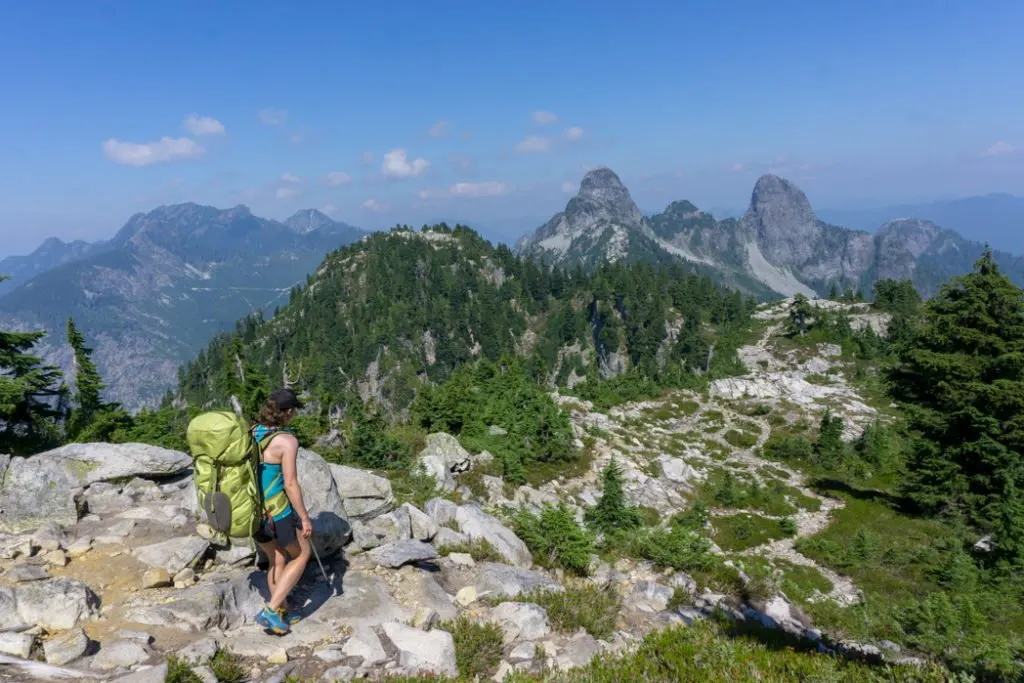
Hiking the Howe Sound Crest Trail near Vancouver, one of the best bacpacking trips in BC
Hiking near the Lions on the Howe Sound Crest Trail

Duration: 2-4 days

Distance: 31.7 km traverse

Best Months: Mid-July to September

Difficulty: Very Challenging

Elevation Gain: 660 m

Fees and Reservations: None.

This very rough trail is more like a route in some places and requires occasional hands-on scrambling moves as you traverse a chain of rocky summits high above Howe Sound near Vancouver. If you’re up for the challenge, the views are worth it.

Watersprite Lake

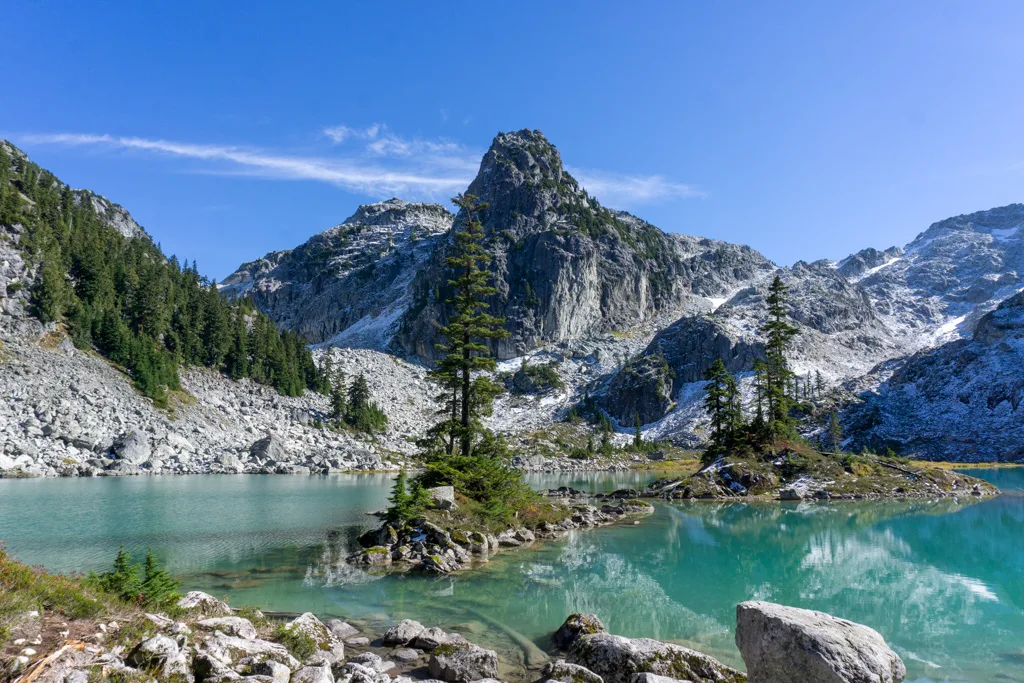
Watersprite Lake in Squamish, one of BC's best overnight backpacking destinations
Watersprite Lake

Duration: 2 days

Distance: 17 km round trip

Best Months: Mid-June to October

Difficulty: Moderate

Elevation Gain: 660 m

Fees and Reservations: The hut requires reservations and costs $20/person/night. Advance reservations and fees are required for camping.

Watersprite Lake is an Instagram sensation thanks to its ice blue water and dramatic rock tower. We can credit the BC Mountaineering Club for building the trail to the lake along with a cabin and campground. I think it’s one of the best hikes in Squamish.

Hike the Skyline Trail in Jasper National Park

The Skyline Trail is one of the most popular backpacking trips in Jasper National Park. And it’s easy to see why – it’s 44 km of spectacular mountain scenery including 25 km above the treeline. I hiked the trail over 3 days in late August and was amazed by its beauty.

I’m a hiking guidebook author and have backpacked all over BC and the Canadian Rockies. So far the Skyline Trail is tied with the Rockwall Trail as one the most spectacular multi-day mountain backpacking trip I’ve done.

My guide to the Skyline Trail in Jasper National Park includes:

This is a sensitive wilderness area. Learn how to Leave No Trace to keep the wilderness wild. Make sure you are prepared by bringing the 10 Essentials. Get ready for adventure with this checklist of things to do before every hike.

Hey there: Some of the links in this post are affiliate links, which means I earn a small commission at no cost to you. Thanks for your support. -Taryn

Skyline Trail Quick Facts

Description: The Skyline Trail is a spectacular hike through the mountains in Jasper National Park. Most of the hike is above the treeline and you cross three mountain passes. There are six backcountry campgrounds and one backcountry lodge along the route.

Location: The Skyline Trail is located in the Rocky Mountains in Canada’s Jasper National Park. The trail runs thought the mountains from Maligne Lake to Signal Mountain Trailhead on Maligne Lake Road near Maligne Canyon.

Distance: 44 km one-way

Elevation Gain: 800-1330m depending on which direction you hike

Difficulty: Moderate. There is one steep and challenging section but the rest of the trail is quite mellow.

How long does it take to hike the Skyline Trail? 2-4 days. Most people will take 3 days. See the itinerary section for more info.

Best time to hike the Skyline Trail: Mid-July to mid-September. The trail is too snowy the rest of the time.

Skyline Trail Weather: The Skyline Trail is the highest trail in Jasper National Park. Most of the trail is above 2000m. In July and August, the average high temperature is 22°C and the average low is 7°C. Thunderstorms in the afternoon are common. Use my picks for the Best Weather Apps for Hiking to see the forecast for your trip.

Skyline Trail Reservations and Costs: You must make reservations to hike the Skyline. It costs about $110.50 per person to hike the trail (including National Park entry fees, backcountry camping fees, a reservation fee, and a shuttle fee). But you can save money by going in a group, hiking faster, or driving yourself. More details are in the reservations and costs sections below.

What to Bring on the Skyline Trail: This is a remote hiking trip, so you will need to bring typical backpacking gear. Use my backpacking checklist to make sure you have everything you need.

Wildlife on the Skyline Trail: The trail is in bear country (both black bears and grizzly bears). Carry bear spray, hike in a group, and make noise, especially in brushy areas. Use campground cooking areas and store all your food in toiletries in bear lockers. Read my bear safety tips for backpackers for more info.

Skyline Trail Rules: Dogs, fires, drones and hammocks are not allowed.

Indigenous Context: The Skyline Trail is in the traditional territory of the Anishinabe, Aseniwuche Winewak, Dene-zaa, Nêhiyawak, Secwépemc, Stoney Nakoda, Mountain Métis and Métis. The government forced Indigenous people to leave when Jasper National Park was created in 1907 and prohibited from accessing their traditional territory to hunt, fish, gather, and conduct cultural practices.